14.5 Maintaining a local ecosystem

Unhas Integrated Plan to Protect Aquatic Ecosystems and Reduce River Pollution

Universitas Hasanuddin (Unhas) has established a comprehensive and integrated plan to safeguard aquatic ecosystems and mitigate river pollution, underscoring its strong commitment to environmental sustainability. This initiative is guided by the Circular Letter No. 41699/UN4.1/KM.01.03/2022, later refined through Circular Letter No. 28720/UN4.1/KM.01.03/2024 on the Protection and Prevention of Marine and Terrestrial Pollution. Together, these policies provide an institutional framework for minimizing human-induced physical, chemical, and biological impacts on marine and freshwater environments.

In collaboration with the Provincial Government of South Sulawesi, the Faculty of Marine Science and Fisheries (FIKP) is developing a Zoning Plan for the Bone Bay Conservation Area. Through this zoning plan, Bone Bay is expected to become a conservation area that protects coastal and marine biodiversity and supports sustainable development in the marine and fisheries sectors across South Sulawesi. This initiative represents a strategic step toward the sustainable management of coastal and marine resources, aiming to preserve biodiversity while supporting the long-term socio-economic development of fisheries and marine sectors in South Sulawesi.

Since 2023, Unhas has partnered with the Maros Regency Government to implement the Trash Trap Program, a pioneering effort designed to intercept plastic waste in upstream river areas before it reaches downstream ecosystems and coastal zones. Following its success, the program has been expanded to multiple regions, including Pinrang, Bone, and Makassar, positioning Unhas as a leading institution in reducing river-based pollution that threatens aquatic biodiversity in Indonesia.

The Trash Trap initiative not only addresses the accumulation of plastic waste but also mitigates the chemical contamination caused by the degradation of plastics into microplastics and toxins. Ecologically, it contributes to restoring the biological balance by protecting aquatic habitats and species from pollution-related threats.

Unhas Strengthens Aquatic Ecosystem Health Monitoring through Conservation, Research, and Community Collaboration

Universitas Hasanuddin (Unhas), through the Faculty of Marine Science and Fisheries (FIKP), continues to strengthen its commitment to aquatic ecosystem health monitoring by combining conservation, research, and community collaboration. In December 2024, FIKP conducted monitoring of marine and terrestrial biota in Pulau Pakal, Pulau Gee, and Tanjung Buli, East Halmahera, near nickel mining operations of PT ANTAM Tbk NMNM and PT Sumberdaya Arindo. The monitoring assessed changes in flora and fauna, covering seagrass, macroalgae, nekton, plankton, benthos, coral reefs, and terrestrial species. According to Prof. Chair Rani, the findings provide valuable references for companies to adopt preventive and corrective measures in mitigating mining impacts.

Complementing this effort, Unhas students from the Student Association of Aquatic Resources Management (MSP) under the Fisheries Student Family (Kemapi) held a Seagrass Expedition to Pulau Bangko-bangkoang, Satando, and Kulambing. The program engaged 88 students in seagrass data collection, ecological analysis, and coastal clean-up, reinforcing both scientific capacity and environmental awareness.

Through these integrated initiatives, Unhas demonstrates its holistic role in monitoring ecosystem health while actively engaging industry, researchers, and students in protecting marine and coastal biodiversity.

Unhas Strengthens Good Aquatic Stewardship Practices

Hasanuddin University (Unhas) continues to demonstrate its commitment to marine ecosystem sustainability through collaboration with local governments. Together with the South Sulawesi Provincial Government and supported by the Australia–Indonesia Centre Partnership for Australia–Indonesia Research (PAIR), Unhas has developed a seaweed cultivation program. This initiative not only aims to improve the welfare of coastal communities but also plays a vital role in maintaining water quality, absorbing carbon, and providing natural habitats for marine life.

In addition, Unhas has partnered with the West Sulawesi Provincial Government to carry out sea turtle habitat conservation. Throughout the implementation and official handover of this conservation program, Unhas demonstrated its concern for protecting endangered marine species. Sea turtles, as key indicators of ocean health, have become a central focus in preserving coastal ecosystem balance.

These initiatives reflect good aquatic stewardship practices that balance economic, ecological, and sustainability interests. With such concrete actions, Unhas positions itself as a pioneer in supporting the achievement of sustainable development goals in Eastern Indonesia.
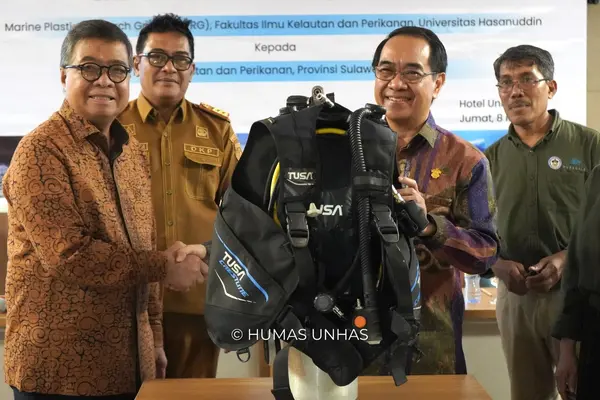


Unhas Dan Pemprov Sulbar Serah Terima Keberlanjutan Konservasi Habitat Penyu di Kepulauan Balabalakang14.5.3 Programs towards good aquatic stewardship practices

Unhas and Community Partnerships for Sustainable Aquatic Ecosystems

Unhas is committed to safeguarding shared aquatic ecosystems through close collaboration with local communities. Together with the Provincial Government of South Sulawesi and the Partnership for Australia–Indonesia Research (PAIR), Unhas promotes sustainable seaweed cultivation to strengthen local economies while protecting marine ecosystems.

The Department of Marine Science at the Faculty of Marine and Fisheries Science also conducts outreach programs at the Environmental Education Center (PPLH) in Puntondo Village, Takalar, to build community awareness and capacity in marine conservation.

In addition, Unhas has expanded its Trash Trap program across rivers in Pinrang, Bone, Maros, and Makassar to intercept plastic waste before it pollutes downstream ecosystems. These traps are community-managed solutions, where local residents maintain the installations and receive incentives from Unhas. This model not only ensures effective waste management but also empowers communities economically, fostering a sense of shared responsibility for environmental protection.

Unhas further strengthens community engagement through digital initiatives, working with Swinburne University of Technology and the Yayasan Konservasi Laut (YKL) Indonesia. This collaboration provides coastal communities in South Sulawesi with improved access to environmental data and supports sustainable resource management.

Through these partnerships, Unhas actively promotes biodiversity conservation, sustainable livelihoods, and long-term ecological stewardship across Indonesia.

In alignment with Unhas Master Plan (2018–2030), Hasanuddin University (UNHAS) has proactively implemented a comprehensive watershed management strategy on its campus, designed to address the specific ecological characteristics and biodiversity of its surrounding aquatic ecosystems.

A key component of this approach is the establishment of Green Open Spaces (Ruang Terbuka Hijau/RTH), covering 47.123 hectares, which constitutes 31.83% of UNHAS’s total land area. These green zones are strategically developed to support ecological balance, improve water absorption, and enhance the sustainability of the campus’s 9.763-hectare lake system. This lake system plays a critical role in supporting a wide range of aquatic species, making it a vital part of the campus’s wetland ecosystem.

The watershed management initiative reflects UNHAS’s strong commitment to environmental responsibility, with a particular emphasis on the preservation of aquatic species and their habitats. By recognizing the importance of location-specific biodiversity, UNHAS ensures that each component of the ecosystem (flora, fauna, water quality, and topography) is considered in the design and execution of sustainable management practices.

Beyond the campus, UNHAS actively collaborates with external stakeholders (LPPM) to expand the impact of its environmental initiatives through the Institute for Research and Community Service. A notable example is the partnership with PT Vale Indonesia Tbk in a tree-planting project around Toraja Airport in Mengkendek Sub-district, Tana Toraja Regency. This initiative supports the rehabilitation of the watershed area, contributing to ecosystem restoration and climate resilience in the region.

In the field of research, UNHAS continues to contribute to watershed and aquatic ecosystem management through specialised units such as the Forest Hydrology and Watershed Management Research Group, accessible at https://trg.unhas.ac.id/secrg/. This center supports data-driven, location-specific research and development activities, enhancing knowledge and practices related to river and groundwater sustainability.