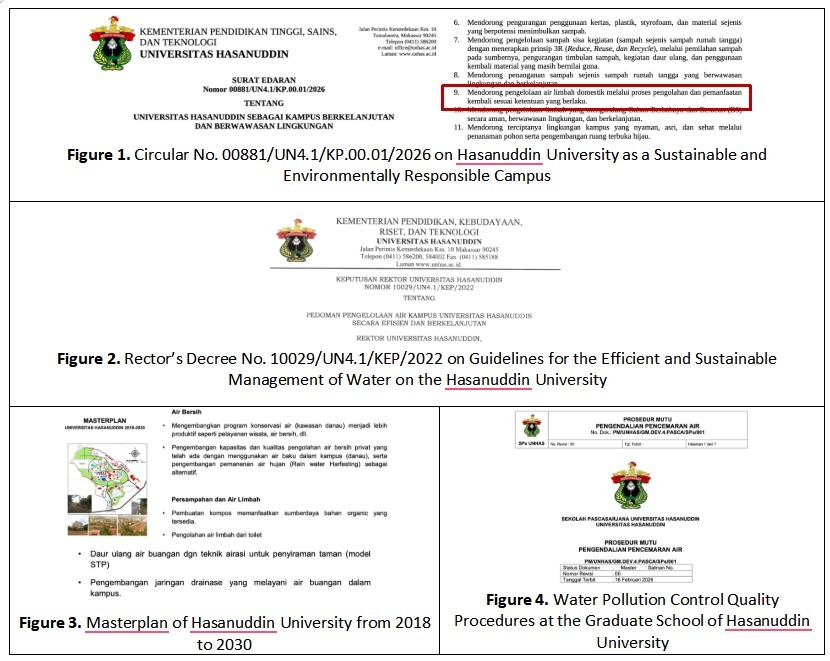
Hasanuddin University demonstrates its commitment to sustainable water management through various institutional policies and regulations. One such initiative is Rector’s Circular No. 00881/UN4.1/KP.00.01/2026 (Figure 1) on “Hasanuddin University as a Sustainable and Environmentally Responsible Campus,” which directs all work units to implement domestic wastewater management through treatment and reuse in accordance with applicable regulations.
This commitment is further reinforced by Rector’s Decree No. 10029/UN4.1/KEP/2022 (Figure 2) on “Guidelines for the Efficient and Sustainable Management of Water on the Hasanuddin University”, stipulates that:
- The water used must comply with government-established quality standards, including SNI 01-3553-2006 and Ministry of Health Decree No. 2 of 2023 regarding drinking water.
- The water conservation program includes a wastewater treatment plant (WWTP), rainwater harvesting, and automatic drip irrigation for garden maintenance. Unhas Lake must be protected from contaminants through regular water quality monitoring.
Furthermore, the same rector’s decision also explains that there are water management strategies categorized based on the characteristics of the campus areas:
- Tamalanrea Campus:Focuses on the protection of aquatic ecosystems and the use of integrated stormwater management systems that drain naturally into water bodies and rivers, taking into account the availability of catchment areas.
- Gowa Campus:Adhering to the principles of the Rainwater Harvesting System. This policy is implemented through the construction of retention ponds, which serve as water conservation areas for water sources surrounding the campus.
Hasanuddin University’s commitment to water resource management is also reflected in the Hasanuddin University Master Plan 2024-2044 (Figure 3). The document outlines various strategies and development plans to ensure the availability of clean water, improve the quality of water services, and optimize the wastewater treatment system. In addition, the master plan also emphasizes the importance of water reuse to promote water efficiency and reduce pressure on water resources. Through this long-term plan, Hasanuddin University demonstrates its commitment to achieving sustainable and environmentally friendly water management on campus.
At the faculty level, the Graduate School of Hasanuddin University has established Water Pollution Control Quality Procedures (Figure 4) as guidelines for preventing contaminated water from entering the campus water system and water bodies in the vicinity of Hasanuddin University. These procedures aim to maintain water quality, preserve the functionality of drainage systems and infiltration areas, and control domestic wastewater to prevent environmental pollution. As part of the implementation, periodic monitoring and evaluation are conducted to assess the campus’s water management and environmental conditions based on several key parameters, including water pH, drainage conditions, sanitation conditions, the condition of water storage tanks, and the condition of infiltration areas and the landscape. These monitoring activities serve as the basis for evaluating the effectiveness of water pollution control measures and ensuring sustainable water resource management on campus.
Additional evidence links:
- https://drive.google.com/file/d/1HEeEmLtg9g_RHojb9n2pPHzlAUgIRc-X/view?usp=share_link
- https://www.unhas.ac.id/wp-content/uploads/2024/10/10029-Pedoman-Pengelolaan-Air-Kampus-UNHAS-Secara-Efisien-dan-Berkelanjutan.pdf
- https://sdgscenter.unhas.ac.id/surat-edaran-masterplan-unhas-tahun-2024-2044-sebagai-pedoman-pelaksanaan-pembangunan-di-lingkup-unhas/
- https://drive.google.com/file/d/1aiIPuOZAOqJt43n846dOxxZ8OWTjW7oU/view?usp=share_link